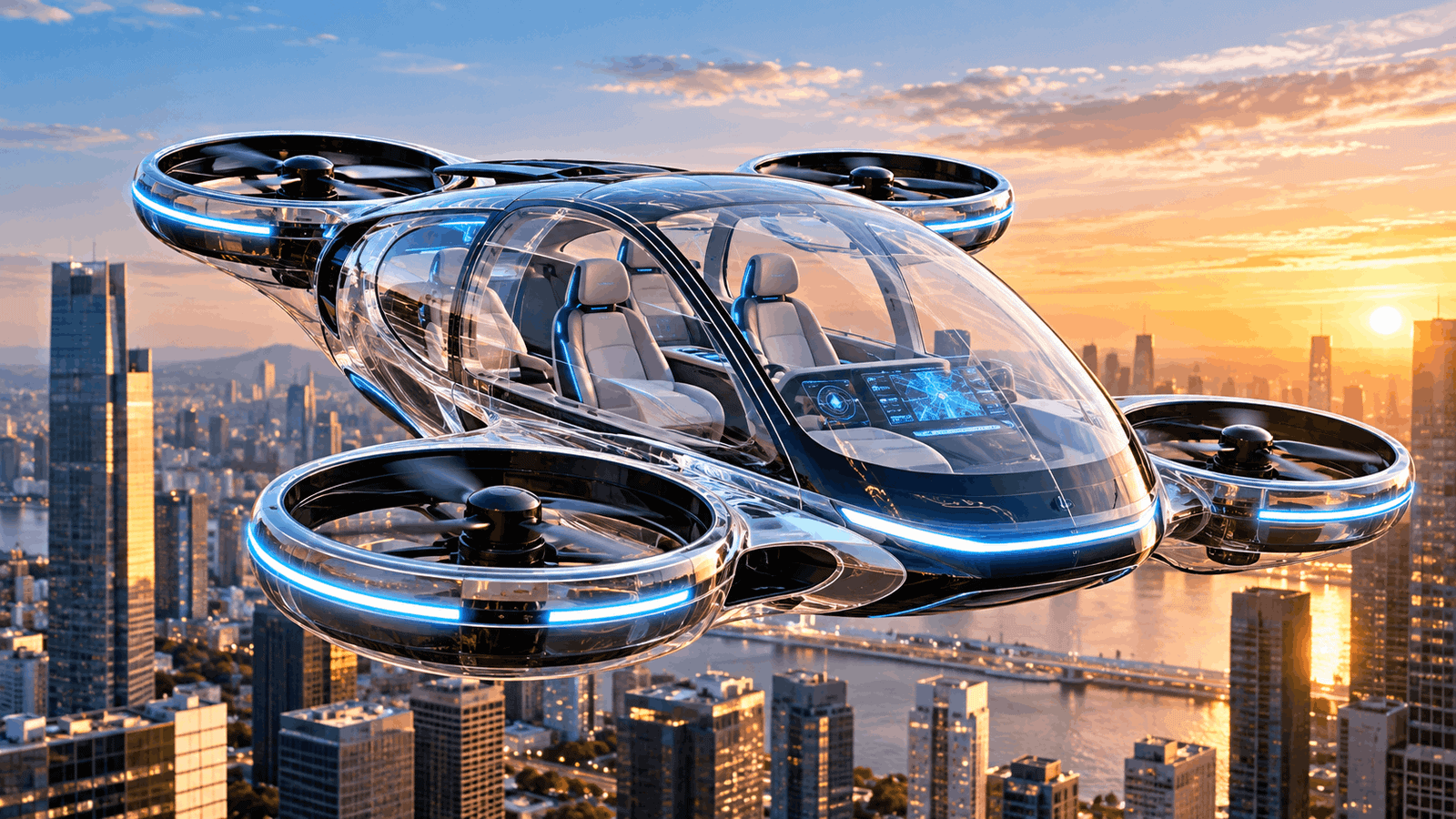
Transparent Flying Car Concept: Is This What the Future of Personal Transportation Could Look Like?
Imagine leaving your home in the morning, getting into a car with a glass-like cabin, and instead of joining a crowded road, simply rising above the traffic. The vehicle has no traditional steering wheel in the way we know it today, no conventional engine under the hood, and its surroundings are visible almost all around you.
That sounds like something from a science-fiction movie. However, the idea of combining road transportation with vertical flight is no longer limited to movies and futuristic illustrations. Engineers and mobility companies are exploring different forms of electric vertical takeoff and landing aircraft, commonly known as eVTOLs.
A transparent flying car concept takes this idea one step further by imagining a vehicle with a large transparent cabin, electric propulsion, advanced sensors, and a compact design intended for short-distance urban travel.
But what would such a vehicle actually be like, and could something similar become practical in the future?
What Is a Transparent Flying Car?
A transparent flying car is best understood as a futuristic vehicle concept rather than a commercially available everyday car.
The idea combines the cabin of a luxury automobile with the vertical flight capability of an aircraft. Instead of depending entirely on roads, the vehicle could potentially take off vertically, travel through designated low-altitude airspace, and land at another suitable location.
The “transparent” part refers mainly to the large glass or transparent canopy surrounding the passenger cabin. A wide field of view could make the experience feel completely different from sitting inside a conventional car.
Passengers could potentially see buildings, roads, landscapes, and the surrounding sky from multiple directions.
Of course, creating a large transparent structure that is lightweight, strong, safe, and suitable for flight would be a significant engineering challenge.
How Could It Fly?
One of the most interesting parts of this concept is its propulsion system.
A future flying vehicle could use several electric motors connected to rotors or ducted fans. Multiple propulsion units would allow the aircraft to generate enough lift for vertical takeoff and landing.
Electric propulsion is particularly interesting for this type of vehicle because electric motors can be compact and controlled very precisely.
During takeoff, the rotors would generate upward thrust. Once the vehicle reaches an appropriate altitude, its flight-control system could maintain stability and manage forward movement.
The actual configuration could vary considerably. Some designs may use multiple rotors, while others could combine lift rotors with separate propulsion systems for forward flight.
This is one reason why the term “flying car” covers a wide range of concepts rather than one specific type of machine.
Why a Transparent Cabin Could Be Useful
A large transparent cabin would not simply be about appearance.
For passengers, visibility could become an important part of the flying experience. A conventional aircraft gives passengers windows, but a futuristic flying vehicle could potentially offer a much wider field of view.
This could be especially useful in an urban environment where passengers might want to see nearby obstacles, landing areas, and other aircraft.
However, transparency introduces its own challenges.
Large windows or transparent panels need to remain strong enough to withstand flight loads and possible impacts. They also need to manage sunlight, heat, reflections, and visibility.
Weight is another major consideration. Aviation designers generally have to pay close attention to every kilogram because additional weight can affect energy consumption and flight performance.
Therefore, making an entire cabin transparent would require advanced materials and careful structural engineering.
Could It Replace Cars?
Probably not in the simple sense of replacing every car on the road.
A flying vehicle would require infrastructure that ordinary cars do not need. Roads already exist almost everywhere, while widespread aerial transportation would require carefully managed takeoff and landing locations.
These facilities are often referred to as vertiports or similar landing infrastructure.
Airspace management would also become extremely important. Imagine hundreds or thousands of electric aircraft moving above a large city. Without sophisticated traffic management, the system would quickly become complicated.
Flying vehicles would therefore likely operate within designated routes and regulated airspace rather than allowing everyone to simply fly wherever they wanted.
The Role of Autonomous Technology
Autonomous systems could play a major role in making future flying vehicles practical.
A flying vehicle would need to constantly understand its surroundings. Cameras, radar, navigation systems, altitude sensors, and other technologies could help the onboard computer detect obstacles and maintain a safe flight path.
Instead of expecting every passenger to become a trained pilot, future systems could potentially automate much of the flight.
However, autonomous aerial transportation would require extremely high levels of reliability.
A software error in a normal car can be dangerous, but an error in an airborne vehicle creates an entirely different safety situation. Redundant systems, emergency procedures, reliable communications, and extensive testing would therefore be essential.
What About the Battery?
Battery technology is another major factor.
Electric motors are efficient, but flying requires considerably more energy than simply moving a vehicle along a road. The aircraft must continuously generate enough lift to remain airborne.
This means battery energy density, charging speed, thermal management, and overall vehicle weight are critical.
A future transparent flying car could become more practical as battery technology improves, but battery limitations remain an important engineering consideration.
For short urban journeys, electric vertical aircraft may eventually become useful if the technology, infrastructure, and regulations develop together.
Safety Would Be the Biggest Challenge
The biggest question surrounding any flying-car concept is not how attractive it looks. It is how safely it can operate.
A practical flying vehicle would need reliable propulsion, redundant control systems, obstacle detection, emergency landing capabilities, secure communication, and strict maintenance procedures.
Weather would also matter.
Strong winds, heavy rain, poor visibility, and other atmospheric conditions could affect flight operations. A system designed for everyday urban transportation would need to handle these conditions or know when flying should be avoided.
For this reason, futuristic flying cars should not be viewed simply as cars with wings or rotors attached. They are closer to a new category of aircraft.
When Could We See Vehicles Like This?
It is difficult to give a precise date.
Different companies and research teams are working on electric vertical aircraft, autonomous flight systems, batteries, lightweight materials, and urban air mobility infrastructure. But moving from a working prototype to a widely available consumer vehicle involves many stages.
Testing, certification, infrastructure, manufacturing, maintenance, insurance, air-traffic management, and public acceptance would all have to develop alongside the technology.
The first practical applications are therefore more likely to focus on specific transportation services rather than privately owned flying cars appearing in every driveway.
The Future of Personal Transportation
The transparent flying car concept represents an interesting vision of how transportation could evolve.
Instead of thinking only about faster roads, future mobility could involve multiple layers of transportation: roads at ground level, rail systems, autonomous vehicles, and potentially electric aircraft operating above cities.
A vehicle with a panoramic transparent cabin, quiet electric propulsion, intelligent flight controls, and autonomous navigation could completely change the passenger experience.
For now, however, the transparent flying car remains a futuristic concept. The technology needed to make such a vehicle affordable, safe, lightweight, reliable, and practical on a large scale still presents major challenges.
What makes the concept exciting is not simply the idea of a car flying above traffic. It is the possibility of redesigning how people move through cities altogether.
If battery technology, electric propulsion, autonomous systems, lightweight materials, and aviation infrastructure continue to advance, some elements of today’s futuristic flying-car concepts could eventually become part of real transportation.
The road to that future, however, will likely be much more complicated than the concept images make it look.